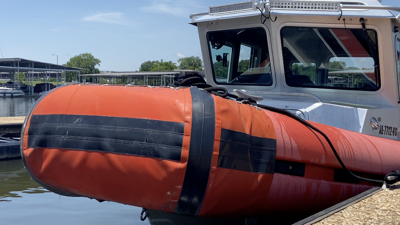
Veterans Against Suicide officially christened the Freedom Fighter at Ditto Landing on Wednesday ahead of an attempt to complete America's Great Loop, a nearly 6,000-mile route through rivers, the Atlantic Ocean, the Great Lakes and the Erie Canal. While the crew hopes to complete the journey in about 12 days and set a speed record, the true mission behind this journey is raising awareness about veteran suicide.
"Mission's over for the boat, but we still found a purpose for it," U.S. Air Force veteran and founder of Veterans against Suicide Dave Scurzik said. "It's just like veterans. You live that mission and then when you're done, you start thinking there's no more purpose. Well, there's always purpose after mission."
Once built to rescue people on the water, the Freedom Fighter now serves as a symbol of the unseen battles many veterans continue to fight long after their military service ends.
"You don't see all the work that's gone into this, and all the problems that were there when we got this boat," Scurzik said. "Just like with the veterans, you don't get to see that. You don't get to see the internal struggles. You don't get to see the injuries that don't leave those scars on the surface, and that's what this boat represents."
That symbolism is deeply personal.
Scurzik lost one of his closest friends in the military to suicide, and nearly lost another after a suicide attempt. Those experiences continue to fuel his commitment to making sure other veterans know they are not alone.
Crew navigator Travis Vlasoff said every mile of the journey is driven by that same purpose.
"Suicide itself is a tremendous issue," Vlasoff said. "It robs families of so much time, and unfortunately it's a huge problem in our veteran community. Our determination to support this community is driving us."
The crew plans to begin the journey next month on July 24. Along the way, they hope each stop becomes an opportunity to start conversations about veteran suicide and encourage those who may be struggling to seek help.
Breaking a record would be an accomplishment, but Scurzik says that isn't the measure of success.
"If we can convince one person to reach out when they're struggling... if we can convince one family member to have that hard conversation with that veteran, that's our success," Scurzik said. "Every one of these 6,000 miles will be worth it."